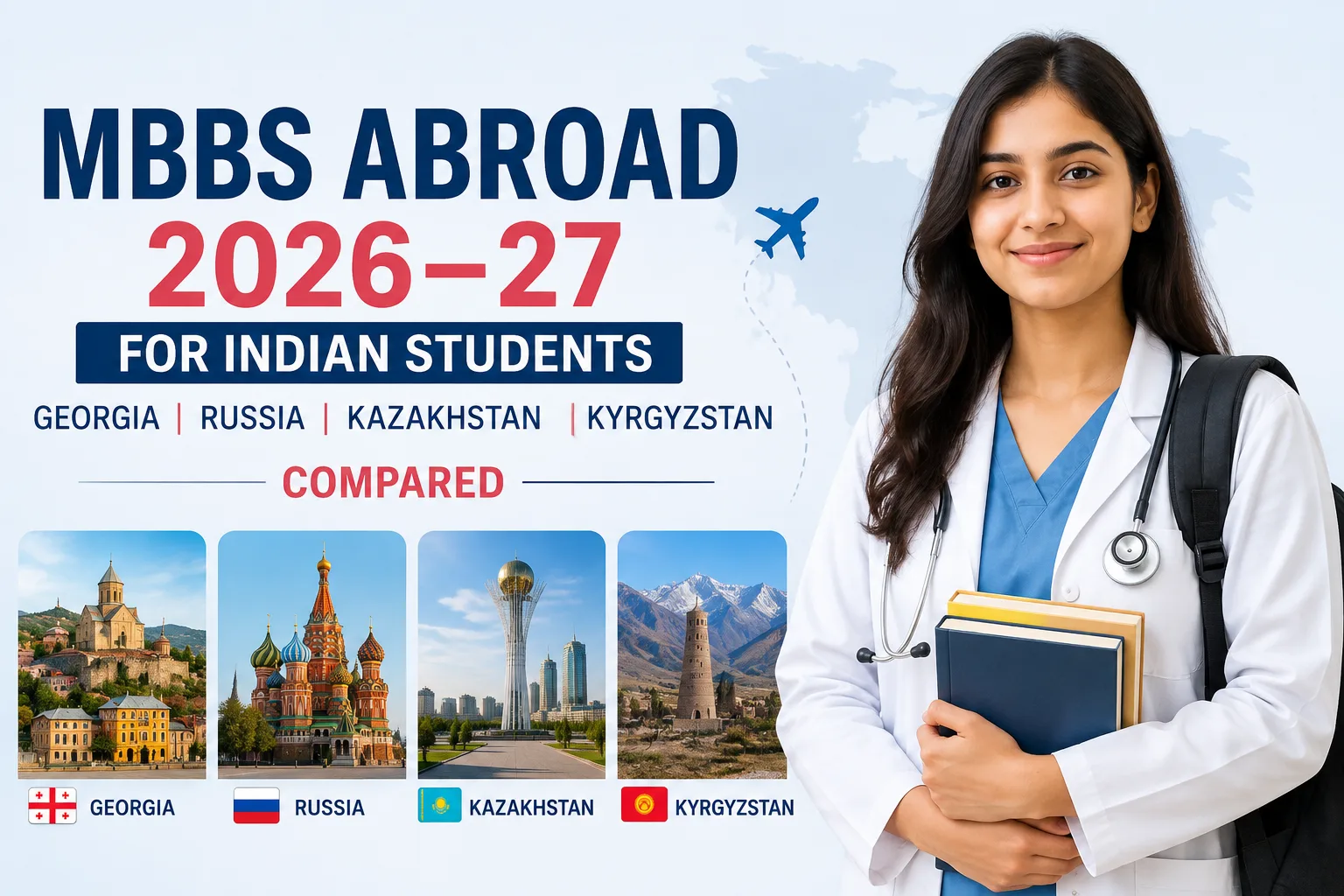
MBBS Abroad 2026–27 for Indian Students: Georgia, Russia, Kazakhstan & Kyrgyzstan Compared
Compare Georgia, Russia, Kazakhstan and Kyrgyzstan for MBBS abroad 2026–27, including course structure, key advantages, NMC requirements and essential checks for Indian students.
✍️ Admin📅 20 Aug 2026📁 Study Abroad
For many Indian students, becoming a doctor is a clear career goal, but limited government medical seats and the cost of private MBBS education can make the journey challenging. This is why MBBS abroad in 2026–27 continues to attract students and parents exploring alternative medical education pathways.
Georgia, Russia, Kazakhstan and Kyrgyzstan are among the destinations commonly considered by Indian medical aspirants. However, choosing a country should not be based only on tuition fees. Course duration, clinical exposure, language, internship structure, university recognition and compliance with National Medical Commission (NMC) regulations are equally important.
MBBS Abroad 2026–27: Quick Country Comparison
Factor
Georgia
Russia
Kazakhstan
Kyrgyzstan
Typical medical program
Around 6 years
Commonly around 6 years
Commonly 6 years
Varies by university/program
English-medium options
Available
Available at selected universities
Available at selected universities
Available at selected universities
NEET for Indian students
Required
Required
Required
Required
Key advantage
Structured medical education & international environment
Established medical education ecosystem
Growing English-medium options
Often considered for affordability
Important check
Internship & licensing compliance
Language during clinical training
Exact program/internship structure
Duration and NMC compliance
Program structures and fees vary considerably between universities. Students should verify the current curriculum and eligibility directly with the university before admission.
1. MBBS in Georgia: Strong Option for International Exposure
Georgia has become a prominent destination for Indian students looking for English-medium medical education.
According to information published by the Embassy of Georgia in India, accredited undergraduate MD programmes in Georgia are generally six years or 360 ECTS, with the sixth year incorporating internship/clinical training.
Why Students Consider Georgia
English-medium MD programmes are available.
Six-year medical education structure is common.
International student environment.
Modern universities and clinical training opportunities.
Convenient connectivity with India compared with some other destinations.
Georgia can suit students whose priority is a structured international medical education environment rather than simply finding the lowest-cost option.
2. MBBS in Russia: Established Medical Education Destination
Russia has traditionally been one of the major destinations considered by Indian students for overseas medical education.
Several universities offer medical programmes to international students, including English-medium options. However, students should carefully investigate how much English is used during the complete course and clinical training.
Why Students Consider Russia
Long-established medical universities.
Large teaching hospitals in major cities.
International student communities.
Multiple university and city options.
Potentially competitive education costs compared with expensive private MBBS options.
Students should also consider climate, local language requirements and the quality of clinical interaction before selecting a Russian medical university.
3. MBBS in Kazakhstan: Emerging Choice for Indian Students
Kazakhstan is another Central Asian destination receiving attention from Indian medical aspirants.
Importantly, students should verify the specific university programme rather than assuming every medical course follows the same structure. For example, Sh. Ualikhanov Kokshetau University states that its 2026–2032 integrated Medicine programme is six years and includes at least 54 months of medical education plus 12 months of clinical internship.
Other institutions also advertise six-year English-medium medical programmes.
Why Consider Kazakhstan?
English-medium programmes are available.
Six-year programmes are offered by several institutions.
Growing international student population.
Multiple medical university options.
Often considered by families seeking a balance between budget and infrastructure.
4. MBBS in Kyrgyzstan: Budget-Focused Option
Kyrgyzstan is frequently explored by students looking for relatively economical overseas medical education.
However, this is also a destination where careful university-level verification is essential. Students should not choose a university simply because an agent advertises low tuition fees or a short course duration.
Before admission, confirm the exact duration of academic study, internship arrangement, clinical training, medium of instruction and eligibility to obtain a medical licence in the country.
Which Country Is Best for MBBS Abroad?
There is no single country that is best for every student.
Choose Georgia if international exposure, English-medium education and a structured six-year programme are major priorities.
Consider Russia if you prefer an established medical education destination with a broad choice of universities.
Explore Kazakhstan if you are looking for six-year English-medium options while comparing affordability and infrastructure.
Evaluate Kyrgyzstan if budget is a major consideration—but verify the programme particularly carefully for NMC compliance.
The final decision should be made at the university level, not merely at the country level.
NMC Rules Indian Students Must Check Before Admission
This is the most important part of planning an MBBS career abroad.
NMC states that Indian citizens/OCI candidates intending to obtain their primary medical qualification abroad must qualify NEET. NMC also notes that the NEET result is treated as the eligibility certificate under the applicable conditions and is valid for three years for pursuing an MBBS or equivalent foreign medical course.
Under the Foreign Medical Graduate Licentiate Regulations framework, students should carefully ensure that their programme meets requirements including:
Minimum 54 months of medical education.
12-month internship in the same foreign medical institution.
English as the medium of instruction.
Required theoretical, practical and clinical subjects.
Eligibility/registration requirements in the country awarding the medical qualification.
Completion of the course, training and internship in accordance with applicable NMC requirements.
Clearing the applicable mandated examination for registration in India.
NMC's published FAQs specifically clarify the 54-month minimum course duration and 12-month internship requirement.
Important: Don't Search Only for “NMC-Approved Universities”
Students and parents often search Google for NMC-approved medical colleges abroad, but this terminology can be misleading.
NMC clearly states that it does not endorse any list of foreign medical institutions or universities. Instead, students are advised to obtain information about course duration, curriculum, fees and internship directly from the university and ensure that the programme meets the applicable regulations.
Therefore, before paying an admission or booking amount, verify the university, exact programme, teaching language, clinical curriculum, internship and licensing conditions.
FAQs
Is NEET compulsory for MBBS abroad in 2026?
Yes. Indian citizens/OCI students intending to pursue MBBS or an equivalent primary medical qualification abroad must meet the applicable NEET requirement if they want the qualification to support medical registration in India.
Which is better for MBBS: Georgia or Russia?
Both can offer suitable options. Georgia is often considered for its English-medium environment and structured six-year MD programmes, while Russia offers a larger established medical education ecosystem. The quality and compliance of the individual university should determine your final choice.
Is Kazakhstan good for MBBS for Indian students?
Kazakhstan can be considered, particularly where universities offer properly structured six-year English-medium programmes. Students must verify curriculum, internship, clinical exposure and licensing eligibility before admission.
Is Kyrgyzstan suitable for Indian medical students?
It can be an affordable option, but students should carefully verify the exact programme duration, internship, teaching language and NMC compliance before selecting a university.
How should I choose the right medical university abroad?
Compare universities on curriculum, teaching hospitals, clinical exposure, internship structure, total cost, language, student support, local licensing eligibility and NMC requirements—not just tuition fees.
Studying medicine abroad can be a valuable route towards a medical career, but the right decision requires more than comparing fees. For the 2026–27 intake, students and parents should shortlist the country first and then perform detailed due diligence on individual universities. A slightly cheaper programme is rarely worth choosing if its curriculum, internship or licensing pathway creates problems after graduation.