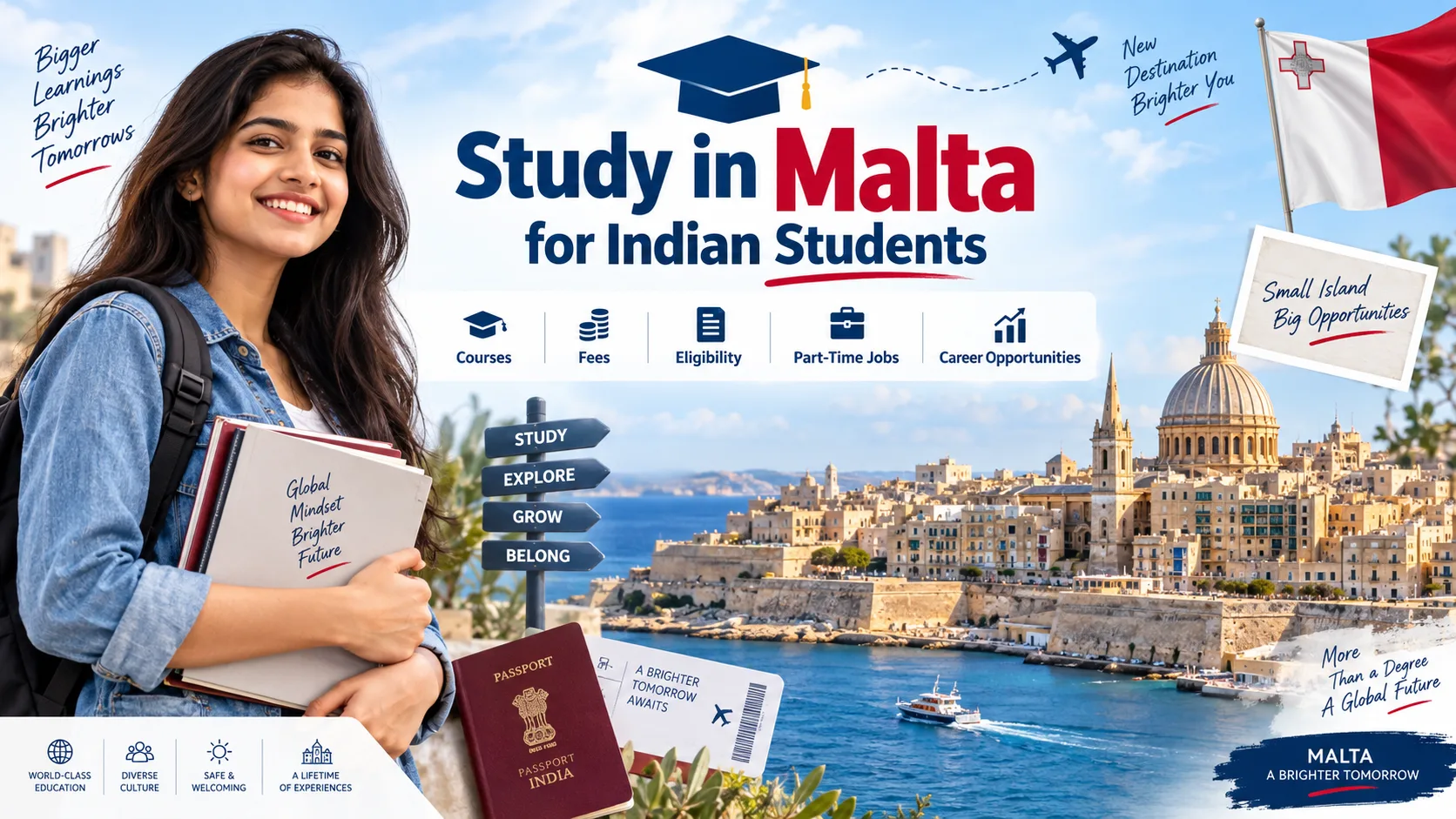
For Indian students looking beyond the traditional UK, Canada or Australia route, Malta is emerging as an interesting European study destination. English-medium education, internationally recognised qualifications, a growing services economy and opportunities to gain international exposure make the country worth considering for undergraduate and postgraduate studies.
However, students should evaluate Malta carefully. Tuition fees, accommodation, course recognition, part-time work rules and post-study opportunities can differ considerably between institutions and programmes.
Here is a practical guide to studying in Malta for Indian students, covering courses, fees, eligibility, living expenses, student jobs and career prospects.
Why Study in Malta?
Malta can appeal particularly to students who want a smaller European study destination with English-medium higher education.
Some potential advantages include:
- English is widely used in higher education
- Access to European academic and professional exposure
- Undergraduate, postgraduate and vocational programmes
- Courses in business, technology, engineering, tourism and healthcare
- Part-time employment possibilities for eligible students
- Growing employment in service-oriented sectors
- A nine-month post-study residence option for eligible graduates
Students should ensure that their institution is licensed by the Malta Further & Higher Education Authority (MFHEA) and that their qualification is appropriately recognised. Malta's study-residence framework specifically refers to recognised higher-education qualifications and licensed institutions.
Popular Courses in Malta for Indian Students
The right course should be selected according to career goals rather than simply choosing the cheapest available programme.
| Study Area | Popular Course Options | Potential Career Areas |
|---|---|---|
| Business | Management, Finance, Marketing | Business, Finance, Sales |
| Information Technology | Computing, IT, Software | IT Services, Development |
| Data & Digital | Analytics, Digital Technologies | Analytics, Digital Business |
| Engineering | Mechanical, Electrical, Electronics | Engineering, Manufacturing |
| Tourism & Hospitality | Hospitality, Tourism Management | Hotels, Tourism, Events |
| Healthcare | Nursing, Health Sciences | Healthcare Services |
| Finance | Accounting, Banking, FinTech | Financial Services |
| Creative Studies | Digital Arts, Media, Design | Media, Design, Content |
Technology-linked programmes can be especially relevant because Malta's labour market has substantial activity across information, communications and professional-service sectors. Jobsplus reported that, at the end of March 2026, 21.6% of full-time employment was in the combined wholesale/retail, transport/storage and information/communication grouping, while professional, scientific, technical, administrative and support services accounted for 20%.
Eligibility for Indian Students
Admission requirements depend on the university and chosen course.
Indian applicants should generally prepare:
- Class 10 and Class 12 certificates for undergraduate admission
- Bachelor's degree for postgraduate programmes
- Academic transcripts
- Valid passport
- English-language proficiency evidence
- Statement of purpose or motivation letter where required
- CV for selected postgraduate courses
- Financial and visa documentation
An important point for Indian applicants is that universities can assess Indian qualifications differently.
For example, the University of Malta currently states that holders of Indian Class XII/Higher Secondary qualifications may be directed towards its foundation pathway programmes for undergraduate progression. Master's applicants are assessed according to the requirements of the individual programme.
English Language Requirements
At the University of Malta, the current Academic IELTS requirements are:
| Level | IELTS Overall |
|---|---|
| Foundation | 5.5 |
| Undergraduate | 6.0 |
| Postgraduate/Doctoral | 6.5 |
Individual component requirements also apply. Universities may accept other approved English tests, so students should always check the exact course requirement before applying.
Tuition Fees in Malta
There is no single tuition fee for studying in Malta. Fees vary according to institution, qualification and subject.
For illustration, University of Malta course pages for the 2026–27 academic year show:
- B.Eng. Mechanical Engineering: approximately €5,400 per year for non-EU applicants
- Several arts, business and IT undergraduate programmes: approximately €8,500 per year
These figures are examples rather than a country-wide fee range. Students should check the latest tuition fee on the specific institution's course page before budgeting.
Cost of Living in Malta
Accommodation is likely to be one of the largest expenses.
The University of Malta currently provides the following realistic monthly estimates:
| Expense | Approximate Monthly Cost |
|---|---|
| Shared accommodation | €550–€700 |
| Private accommodation | €800–€1,600 |
| Food & beverages | €450 |
| Mobile/Wi-Fi | €30 |
| Laundry | €80–€100 |
| Utilities | Around €50 |
| Other expenses | €200–€300 |
Public transport is listed as free for eligible e-residence permit holders.
Indicative Student Budget
Typical monthly expenses with shared housing
Accommodation €550–700 █████████████
Food €450 █████████
Other expenses €200–300 █████
Laundry €80–100 ██
Utilities €50 █
Mobile/Wi-Fi €30 █
A realistic monthly budget using shared accommodation can therefore exceed €1,300, depending heavily on lifestyle and housing choices.
Can Indian Students Work Part-Time in Malta?
Yes, eligible international students can work while studying, but there are important conditions.
Third-country nationals require an Employment Licence from Jobsplus before starting employment.
Eligible students can generally work for a maximum of:
20 hours per week
For students pursuing a recognised full-time higher-education qualification, employment may be possible from the first year after the appropriate residence permit and work authorisation are issued. Other students on qualifying programmes lasting more than 90 days may only be permitted to work after their first three months of study.
Malta's authorities also note that employment related to the student's field of study may receive more favourable consideration.
Part-time earnings should therefore be treated as supplementary income, not as the primary method of financing tuition and living expenses.
Malta Student Visa and Residence Permit
Indian nationals planning long-term studies generally require the appropriate National Long-Stay Visa (Type D) before travelling for programmes exceeding the short-stay period.
For higher-education study residence permits, the programme normally needs to be full-time, offered by a licensed institution and lead to a recognised qualification at the appropriate Malta Qualifications Framework level.
Students should typically prepare documents covering:
- University admission
- Passport
- Tuition/payment evidence
- Financial resources
- Accommodation
- Health requirements
- Insurance where applicable
Visa and residence requirements can change, so applicants should verify them directly with Identità Malta before submitting an application.
Career Opportunities After Studying in Malta
Malta has a relatively small labour market, so students should approach career planning realistically.
Potential sectors include:
- Information technology
- Financial and insurance services
- Professional services
- Tourism and hospitality
- Retail and logistics
- Healthcare
- Digital services
- Engineering and technical roles
Jobsplus data also shows that Malta had 307,783 people in full-time employment at the end of March 2026, with 82% employed in the private sector.
Students with specialised skills, relevant internships, strong English communication and practical experience are likely to be better positioned than those relying only on their qualification.
Post-Study Work Opportunities in Malta
Malta currently provides eligible non-EU graduates with a post-study residence permit of up to nine months after completing an MQF Level 5 or higher qualification.
The period is designed to allow graduates to search for employment or pursue qualifying business opportunities. It is a one-time, non-renewable permit and must be applied for while the student's existing residence permit is still valid.
Importantly, the nine-month residence permit is not itself a full-time work permit.
Once a graduate receives an appropriate job offer, the relevant employment/work residence permission must be obtained before starting full-time employment.
Is Malta Worth It for Indian Students?
Malta can be a good option when the course, institution, budget and career plan are properly matched.
Students should evaluate:
Course Recognition → Total Cost → Employability → Work Rules → Career Pathway
Choosing Malta simply because it is located in Europe is not enough. A recognised programme with relevant industry exposure and a realistic financial plan will usually provide much stronger value.
For Indian students planning to study abroad, Malta deserves consideration alongside larger destinations—but the decision should be based on career fit and return on investment rather than destination popularity alone.
FAQs
Is Malta good for Indian students?
Malta can be suitable for Indian students seeking English-medium education and European exposure, particularly in business, IT, tourism, finance and related areas.
Can Indian students work while studying in Malta?
Eligible students may work up to 20 hours per week, subject to their residence status and obtaining the required Jobsplus Employment Licence.
How much does it cost to live in Malta as a student?
Using University of Malta estimates, students using shared accommodation should plan for roughly €1,300 or more per month depending on rent and lifestyle.
Is IELTS required for Malta?
Requirements depend on the university. The University of Malta currently requires IELTS 6.0 overall for undergraduate study and 6.5 for postgraduate study where IELTS is used to satisfy its English-language requirement.
Can I stay in Malta after graduation?
Eligible graduates who complete an MQF Level 5 or higher qualification can currently apply for a post-study residence period of up to nine months to seek employment or qualifying opportunities.
Is a part-time job guaranteed in Malta?
No. Permission to work does not guarantee employment. Students must find an employer and satisfy the applicable Jobsplus work-authorisation requirements.
Related Articles
Continue reading with handpicked posts from our blog.
 Study Abroad
Best Countries to Study Abroad in 2027 for Indian Students: Fees, Scholarships, Jobs & ROI
Compare the best countries to study abroad in 2027 for Indian students, including the UK, USA, Germany, Australia, Ireland, New Ze...
 Study Abroad
New Zealand Study Visa 2027 for Indian Students: Short-Term Graduate Work Visa, Post-Study Work Rights, Fees & Eligibility
Planning to study in New Zealand in 2027? Understand student visa fees, financial requirements, 25-hour work rights, the new 6-mon...
 Study Abroad
January & February 2027 Intakes Abroad: Universities, Deadlines, Courses & Application Timeline for Indian Students
Planning to study abroad in early 2027? Explore January and February intake universities, application deadlines, popular courses,...